AI companion plush toys are moving from novelty shelves into a broader conversation about play, comfort, and connected products. The opportunity is real, but market figures need careful reading. Circana reported that global toy sales grew 7% in 2024. Grand View Research valued the global artificial intelligence market at about $279.2 billion that year and forecast strong growth through 2030. These figures describe different markets. They do not prove demand for AI-enabled plush toys specifically.
For business buyers, sourcing means assessing more than a soft exterior and a voice demo. Ask suppliers for material specifications, battery details, interaction samples, and documented quality checks. Test whether the toy understands a child’s quiet voice in a busy room. Check how it handles a dead battery, a lost connection, or a question it cannot answer. Small details matter. A scratchy seam can undo the appeal of an otherwise clever product.
Also review applicable toy safety, privacy, labeling, and radio requirements for each destination market. Standards and obligations vary, so verify them with qualified testing and compliance partners. Request current test reports, confirm which factory and product they cover, and arrange independent inspections when appropriate. A polished sample is not proof of consistent production. That point is easy to miss. No supplier can remove every sourcing risk, and AI features can create new ones. This guide explains how to compare manufacturers, validate product claims, and build a sourcing process that balances commercial potential with careful review.
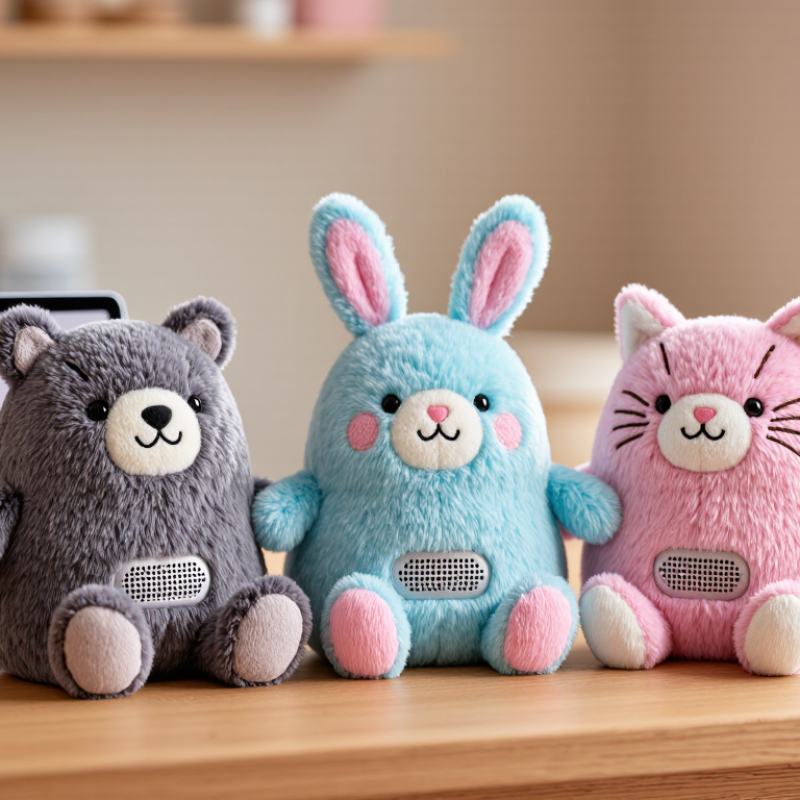
Assess Demand: Circana Valued U.S. Toy Sales at $40.2B in 2023
Circana valued U.S. toy sales at $40.2 billion in 2023, an 8% decline from 2022. That figure shows a large market, but it does not prove demand for AI companion plush toys. Treat it as context, not a sales forecast. Before placing a large order, compare search interest, preorder requests, and customer feedback across your own sales channels. Test a small batch with clear age guidance and a defined feature set. A soft fabric face, understandable voice responses, and simple controls may matter more than a long feature list. I would not assume every shopper wants a talking toy; some may prefer a quiet, screen-free companion.
Tips: Ask suppliers for working samples, battery-life results, washable-part guidance, and written details on how voice data is handled. Test responses in a noisy room, not just a quiet office. Keep notes.
When reviewing quotes, compare unit price with packaging, setup instructions, replacement parts, and minimum order quantity. Request documentation for applicable toy-safety testing, and verify that it covers the exact model and materials you plan to sell. Circana’s broad market figure cannot answer whether a particular design will convert. That part is uncertain. Track returns and repeated customer questions after launch, then adjust the next order rather than relying on optimistic supplier projections.
How to Source AI Companion Plush Toys for Your Business - Assess Demand: Circana Valued U.S. Toy Sales at $40.2B in 2023
| Assessment dimension | Data or measurement | How to use it when sourcing |
|---|---|---|
| U.S. toy retail sales, 2023 | $40.2 billion | Use as broad market context, not as an estimate of demand for AI companion plush toys specifically. |
| Year-over-year change in U.S. toy sales | Down 8% in 2023 versus 2022 | Plan conservatively and validate demand for the product concept with customer research and small test orders. |
| AI companion plush category size | Not specified in the cited U.S. toy sales headline figures | Do not treat total toy-market sales as a category forecast. Estimate demand from your own target audience and sales channels. |
| Target-customer demand test | Track qualified survey responses, preorder conversion, and customer feedback by age group and intended use. | Compare results with the planned retail price before committing to a production quantity. |
| Supplier quote comparison | Record unit price, minimum order quantity, sample cost, tooling charges, lead time, and shipping terms for each quotation. | Compare like-for-like specifications; a lower unit price may be offset by higher setup costs or a larger minimum order. |
| Landed cost and break-even volume | Landed unit cost = product, packaging, freight, duties, and inspection costs per sellable unit. Break-even units = fixed launch costs ÷ contribution per unit. | Build the calculation from actual written quotes and your intended selling price; do not rely on factory unit price alone. |
| Safety and regulatory readiness | Confirm applicable toy safety, labeling, battery, and electronic-product requirements for each intended market and age grade. | Request test reports for the exact final product configuration and verify that materials, electronics, and age grading match the reports. |
| AI features and privacy | Document whether the toy records voice, connects to an app or network, stores data, or uses cloud-based processing. | Assess privacy, parental controls, data handling, connectivity support, and ongoing service costs before approving the product. |
FAQS
Identify the sales destination and intended age group. Check the applicable toy safety requirements. Keep the reports.
No. Ask for reports covering the exact design, materials, and age grade. Small changes can matter.
Check seams, small attachments, coatings, and stuffing. For interactive toys, inspect wiring, batteries, charging parts, and wireless functions.
Request laboratory reports, material declarations, and production records. Confirm the tested sample matches the final toy, including its voice module and battery compartment.
Include different colors, sizes, and production dates when possible. Give each toy the same routine: conversation, button presses, charging, and standby.
Divide units needing repair or replacement by units tested. Test battery life during realistic daily use, not just continuous playback.
Score responses for relevance, tone, and basic prompt-following. Keep sample conversations, but avoid collecting unnecessary personal data. The scoring may still be subjective.
Track return reasons for at least one sales cycle. Keep a few units for repeat checks. A small pilot can miss rare problems.
Conclusion
Sourcing AI companion plush toys starts with understanding whether customers are likely to want them. U.S. toy sales reached an estimated $40.2 billion in 2023, offering useful market context, but businesses should also research their own audiences and price points. Define the product before contacting suppliers: set an age grade, choose suitable AI features and connectivity options, and establish clear privacy requirements for any data the toy may handle.
Next, compare suppliers on minimum order quantities, production capacity, plush materials and construction, and total costs. Request documentation to help verify that the product meets relevant toy safety requirements, including ASTM F963-23, EN 71, ISO 8124, and applicable CPSC rules. Before placing a large order, run a pilot and evaluate defect rates, battery life, AI response quality, and customer returns. These checks can reveal practical issues early and help determine whether the product and supplier are ready for a wider launch.