Sourcing AI plush dolls in 2026 means balancing a soft, appealing toy with technology that works reliably. Buyers need to examine more than sample photos. They should test voice recognition in a noisy room, check stitching around the face and limbs, and confirm how the doll handles charging, updates, and personal data. Small details matter. A loose seam or awkward pause can quickly undermine trust.
AI expert Andrew Ng has described artificial intelligence as “the new electricity.” His comparison offers useful context, though it is not specific to plush toys: AI can become part of everyday products, but its value depends on thoughtful implementation. For sourcing teams, that means asking suppliers for clear component specifications, repeatable quality checks, and realistic demonstrations—not just polished videos. It also means checking whether the doll’s responses suit its intended age group and whether its functions can be explained plainly to caregivers. A prototype may charm everyone at a trade show, yet struggle after hours of repeated use. That gap deserves attention.
This guide outlines how to evaluate suppliers, compare materials and interactive features, review production samples, and plan quality control for 2026. It also considers practical trade-offs, including cost, repairability, and product support. Not every feature earns its place. The strongest sourcing decision may be the less flashy one: a dependable AI plush doll that feels good in a child’s hands and behaves consistently at home.
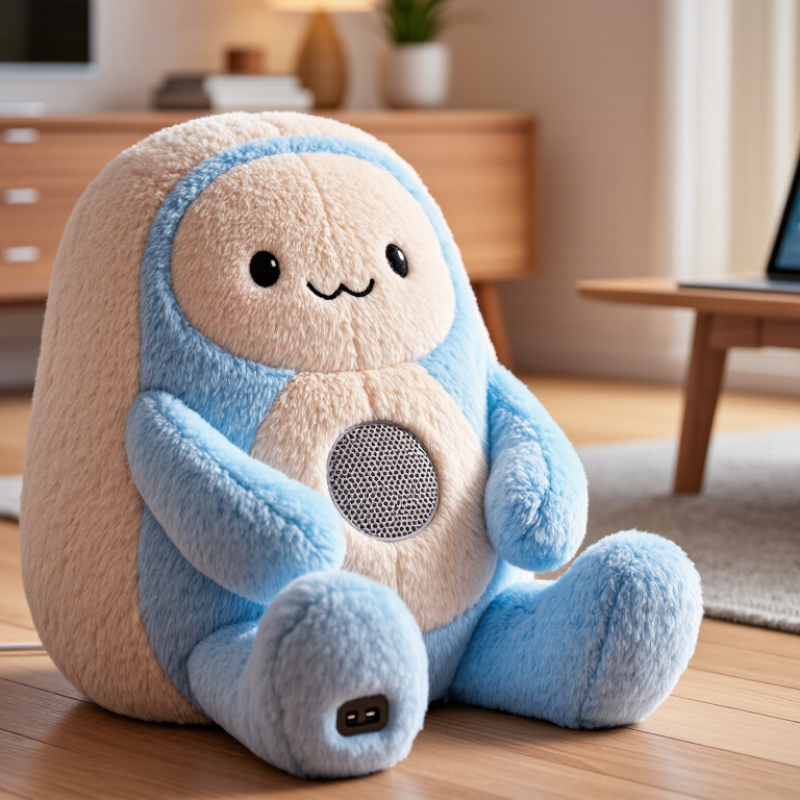
Define the specifications before requesting factory quotes. Record the doll’s finished height, weight, seam positions, fabric pile length, and stuffing firmness. A 30-centimeter doll with a 12-centimeter head, for example, gives suppliers a clear starting point. Specify voice features too: supported languages, microphone placement, speaker volume, response time, and whether core play works offline. Small details matter.
Circana’s 2024 global toy market review reported that toy sales rose 7% across 12 tracked markets. That growth makes a clear product brief useful, but it does not guarantee demand for an AI plush. Set measurable sample checks: target a defined voice-response time, battery runtime, charging method, and sound level. Name the fabric composition and care instructions, then test whether the electronic module can be removed before washing. Ask for material and product test records relevant to your intended markets; do not rely on a supplier’s verbal assurances alone. Some trade-offs remain. A softer body can make module placement harder.
Tips: Send suppliers a one-page spec sheet with reference photos, dimensions, interaction examples, and pass/fail criteria. Test a working sample with children and caregivers, record confusing replies, and revise the brief before bulk production. Keep privacy expectations specific: describe what the device collects, where voice data is processed, and how users can delete it.
How to Source AI Plush Dolls in 2026?
Identify and Screen Potential Manufacturers
Screen manufacturers for proven capabilities, not polished videos. IDC’s 2024 Worldwide AI and Generative AI Spending Guide projected global AI spending would reach $632 billion by 2028, reflecting a fast-growing, complex supply chain. That figure is not a forecast for plush toys, but it signals why buyers should check who builds each component. Ask for a bill of materials showing the plush shell, speaker, microphone, battery, processor, and any outsourced modules. Proof beats polish.
Request a working sample and test it in a quiet room and beside ordinary background noise. Check response delays, speech recognition, volume, seams, and whether the doll behaves sensibly when offline. Ask where voice recordings are processed, whether they are stored, and how they can be deleted. “We use secure AI” is not a sufficient answer. Request written explanations and relevant test records, then verify that production samples match the approved prototype.
Review the factory’s quality procedures, defect logs, capacity, and subcontractor list. A site visit or independent audit can help confirm that the stated process exists beyond the sales meeting. Also ask how firmware updates are tested and what happens when a component changes mid-run. NIST’s AI Risk Management Framework offers a useful reference for discussing risk controls, though it does not certify a supplier. One awkward detail: even a capable factory may lack strong documentation. Treat that gap as a risk to investigate, not a promise to trust.
When sourcing AI plush dolls in 2026, test the interaction, not just the feature list. Ask suppliers to demonstrate voice recognition in a noisy room and explain whether speech is processed on-device or sent to a server. Check what the doll stores, how long recordings remain, and whether caregivers can delete them.
Pew Research Center reported in 2023 that 81% of U.S. adults felt the risks of companies collecting personal data outweighed the benefits. That concern matters when a soft toy listens near a child’s bed. Small details count.
Request a clear data-flow diagram, sample privacy notices, and evidence of access controls. A microphone that stays active after play ends deserves extra scrutiny. So does a vague promise to “improve the AI.”
Ask what data supports that improvement, and whether it includes children’s conversations. Suppliers may not have neat answers yet; record the gaps rather than assuming they are harmless.
Physical safety needs the same attention. Review age grading, seam strength, battery access, washable-fabric instructions, and small-part testing.
The U.S. Consumer Product Safety Commission estimated 231,700 toy-related emergency-department injuries among children aged 14 or younger in 2023. That figure does not predict a plush doll’s risk, but it underlines why testing matters.
Request current, product-specific test reports from qualified laboratories, then inspect a production sample yourself. A cuddly exterior can hide a stubborn battery door.
Some checks still need human hands.
Before placing a production order for AI plush dolls, request samples from at least three suppliers. Give each the same specification: fabric type, doll dimensions, embroidery, voice functions, and battery access. This makes comparisons more useful. A sample reveals details a quote cannot: scratchy seams, uneven stuffing, loose cable routing, or a speaker muffled beneath the fleece. Test each doll more than once. Check response time, volume consistency, charging behavior, and microphone performance through the fabric. Keep dated photos and notes; memory is unreliable.
Ask for an itemized quote covering sample fees, revisions, tooling, electronics, packaging, inspection, and shipping. Compare unit prices at several order quantities, since a low price may depend on a larger minimum order. Confirm what happens if a sample needs changes, and whether revised samples cost extra. Also ask for realistic production and shipping estimates. A spreadsheet helps, but it can still hide costs when suppliers define “finished product” differently.
The cheapest sample may not predict the best production result. Request details about the materials and components used in the sample, then confirm they match the proposed production specification. Compare charging components and included accessories, too. If one quote is much lower, ask which items are excluded rather than assuming it is a bargain. Even careful comparisons leave some uncertainty; samples cannot prove every production unit will be identical. Keep the approved sample and written specifications together for later checks.
Planning comparison only: The figures below are illustrative USD estimates for anonymous supplier profiles, not verified supplier quotations. They assume a roughly 25–30 cm plush toy with a basic voice-interaction module, speaker, microphone, rechargeable battery, and simple control electronics. Unit prices are indicative EXW estimates; freight, duties, taxes, software or cloud-service fees, and final compliance testing are excluded. Actual costs depend on design, materials, order terms, and destination market.
| Comparison dimension | Supplier Profile A Basic configuration |
Supplier Profile B Mid-range configuration |
Supplier Profile C Feature-rich configuration |
What to check when requesting a sample |
|---|---|---|---|---|
| Indicative MOQ | About 500 units | About 1,000 units | About 1,000–2,000 units | Confirm MOQ for the exact fabric, character design, electronics, and packaging—not just a standard product. |
| Estimated unit cost at 500 units | $28–$42 | $32–$48 | $40–$60 | Ask for a cost breakdown covering plush materials, electronics, assembly, packaging, and any one-time charges. |
| Estimated unit cost at 1,000 units | $24–$36 | $28–$42 | $36–$54 | Request the same specification and price basis from every supplier so the quotes are comparable. |
| Estimated unit cost at 3,000 units | $20–$31 | $24–$36 | $31–$47 | Ask whether volume pricing assumes one design, one fabric color, and a single shipment. |
| Sample and development estimate | $80–$180 per sample | $120–$250 per sample | $180–$350 per sample | Clarify whether the fee includes a working electronics prototype, revisions, shipping, and a credit against a bulk order. |
| Possible one-time tooling or setup | $300–$1,200 | $500–$2,000 | $800–$3,000 | Check what is included, who owns custom patterns or molds, and whether repeat orders incur setup charges. |
| Indicative sample lead time | About 2–4 weeks | About 3–5 weeks | About 4–7 weeks | Confirm timing for both the plush prototype and the functioning voice module; these may be developed separately. |
| Indicative bulk production lead time | About 30–50 days after sample approval | About 35–60 days after sample approval | About 45–75 days after sample approval | Ask when the production clock starts and whether material sourcing, testing, and peak-season capacity affect the schedule. |
| Electronics and interaction details | Basic recorded or limited voice functions | Voice-interaction module with configurable functions | More customized hardware or interaction features | Test microphone pickup, speaker clarity, battery life, charging method, privacy controls, and operation without an app or network if required. |
| Quality and safety documentation | Request component and material records | Request test reports for the intended market | Request reports covering the finished toy and electronics | Requirements depend on destination and product design. Verify applicable toy, chemical, battery, radio, and electrical requirements with a qualified testing provider. |
| Best fit for | Early validation with simpler features | Balancing customization and unit cost | More complex designs or integrated features | Choose based on tested sample quality, documented capabilities, total landed cost, and realistic delivery commitments—not unit price alone. |
Before ordering AI plush dolls, ask suppliers for current test reports, material declarations, and a clear list of product components. Requirements vary by destination market, so check the rules that apply to the finished toy, not just its fabric. If it contains a microphone, speaker, battery, or wireless module, request relevant electrical and radio-frequency documentation. Ask how voice data is handled and whether recording can be disabled. Paperwork matters.
Then verify production capacity with evidence. Request a live video walkthrough of the sewing line, electronics assembly area, and finished-goods storage. Compare the promised monthly output with staffing, machine availability, and recent order records. Ask for a pre-production sample and inspect seams, stuffing density, sound quality, and wash-care labels. A neat spreadsheet can still mislead. I would also ask what happens when a component arrives late; vague answers deserve follow-up.
Shipping plans need the same scrutiny. Get a written timeline covering sample approval, production, inspection, packing, and transit. Confirm carton dimensions, shipment terms, tracking arrangements, and who handles customs documents. Ask whether the supplier has a backup carrier during peak periods. Build in extra time for inspection or rework; small delays can compound. One detail is easy to miss: test a packed sample for crushing before approving the final carton.
These are selected U.S. limits for children’s products, not a complete testing plan: lead is limited to 100 ppm in accessible component parts and 90 ppm in paint or similar surface coatings. The 1,000 ppm phthalate limit applies to specified phthalates in covered children’s toys and child-care articles. Confirm product scope, testing, and required certificates with a qualified lab before production; also verify factory capacity and shipping schedules separately. Sources: CPSC lead guidance and CPSC phthalates guidance.
Ask for a bill of materials covering the plush shell, microphone, speaker, battery, processor, and outsourced parts. Request evidence of who builds each component. Polished videos are not proof.
Try it in a quiet room and beside ordinary background noise. Check response delays, speech recognition, volume, seams, and offline behavior. Listen closely.
Ask where recordings are processed, whether they are stored, and how caregivers can delete them. Request a data-flow diagram and written privacy details. Vague promises need follow-up.
Check age grading, seam strength, battery access, washable-fabric instructions, and small-part test reports. Inspect a production sample yourself. A soft exterior can hide a stubborn battery door.
Review defect logs, quality procedures, capacity, and subcontractor lists. Ask how firmware updates are tested and how component changes are managed. Documentation may be weaker than expected.
Request a live walkthrough of sewing, electronics assembly, and finished-goods storage. Compare promised output with staffing and recent order records. A spreadsheet can mislead.
Request current, product-specific test reports and material declarations. Check documentation for the finished toy and its electronic components. Keep a record of unanswered questions.
Get written dates for sample approval, production, inspection, packing, and transit. Confirm carton size, tracking, and customs-document responsibilities. Test a packed sample for crushing. Delays happen.
Sourcing AI plush dolls in 2026 starts with clear product specifications. Decide on the doll’s size, materials, appearance, intended age range, interactive functions, and expected price. These details help potential manufacturers understand the project and make their proposals easier to compare. Screen suppliers by reviewing their relevant experience, communication, quality-control processes, and ability to support development from prototype to production.
Next, evaluate how the AI features work, what data they may handle, and how privacy and product safety are addressed. Request samples to assess workmanship, comfort, durability, and interactive performance, then compare quotes alongside tooling, packaging, and other production costs. Before choosing a supplier, confirm that the product and its components can meet the requirements for the intended market, and verify production capacity, timelines, inspection procedures, and shipping arrangements. A careful, step-by-step review can reduce surprises and help ensure the finished doll matches the project’s needs.