0%

In 2026, talking stuffed animals are more than toys that repeat a phrase. Some sing, tell stories, answer simple prompts, or respond when a child squeezes a paw. Others keep things simple: a soft bear, a clear voice, and one familiar bedtime line. Small differences matter.

The market is broad, but public reports rarely isolate talking plush toys as a separate category. Circana’s 2024 review reported that U.S. toy sales fell 8% in 2023, a reminder that popularity and lasting value are not the same thing. The Toy Association’s annual trend reporting also tracks interests such as interactive play and toys that support emotional connection. These broader signals help frame the choices, though they cannot tell us which talking animal every child will love.

Play researcher Dr. Stuart Brown puts the value of play plainly: “The opposite of play is not work—it’s depression.” His observation is not a product ranking, and it should not be treated as one. Still, it helps explain why a comforting voice or a playful response may matter beyond novelty. Not every feature earns its place. A parent may prefer a quieter toy with simple controls; a child may want a chatty dinosaur that repeats the same joke all afternoon. This guide compares the leading types of talking stuffed animals in 2026, including story-telling companions, interactive pets, singing plush toys, and customizable voice-response models. It also considers sound quality, ease of use, age suitability, and how well each toy fits real routines.
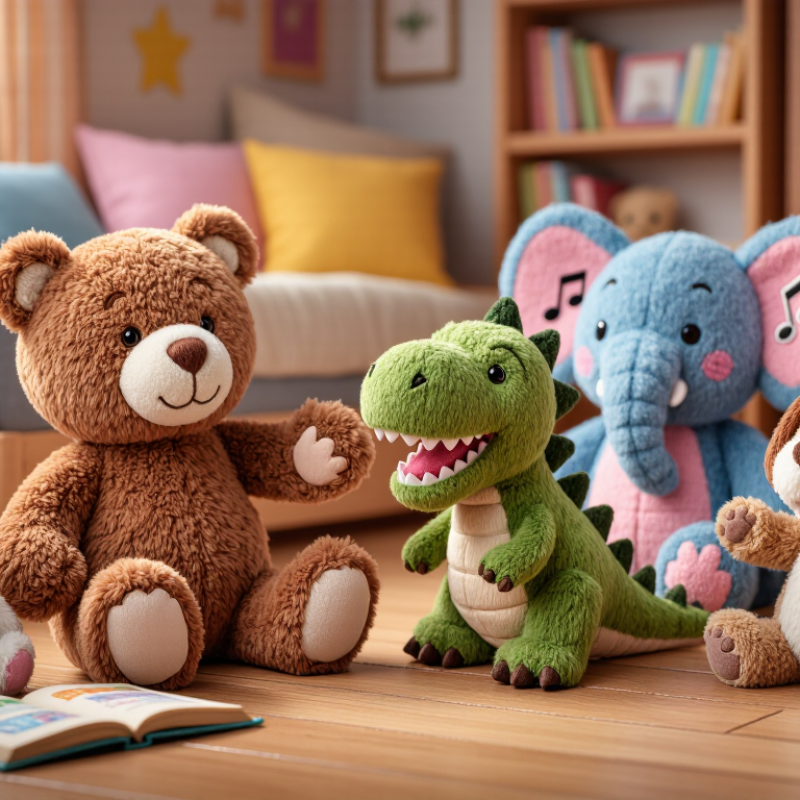
What Are the Top Types of Talking Stuffed Animals in 2026?

Classify Talking Plush by Four Modes: Playback, Recording, Sensors, and AI

Talking stuffed animals in 2026 generally use four interaction modes: playback, recording, sensors, or AI. Playback models repeat preset phrases or songs when a paw is pressed. They are simple to operate and suit predictable bedtime routines. The trade-off is repetition; the same cheerful line can feel less charming after the tenth replay. Recording models let a caregiver save a short personal message. Check how recording works, and whether it can be easily replaced.

Sensor-based plush responds to touch, movement, or sound. A squeeze might trigger a giggle, while a tilt could start a lullaby. These reactions can make play feel more immediate, but sensors may misread rough handling or noisy rooms. Small detail, big difference. Look for clear instructions on where to press and how to adjust volume.

AI-enabled toys can generate more varied responses, sometimes using speech recognition or a connected service. Their conversations may feel flexible, but responses are not always predictable or age-appropriate. Check whether the toy connects to an app, what audio it stores, and how settings can be changed. The categories can overlap: a plush may combine recorded phrases with touch sensors. That makes comparison a little messy, so focus on the child’s routine, the controls, and how reliably each feature works.

Compare Push-Button Playback with Record-and-Repeat Plush

Talking stuffed animals usually use either push-button playback or record-and-repeat audio. A push-button model plays preset phrases when a child presses a paw or belly. It is simple to operate and delivers consistent sound. Record-and-repeat plush lets a caregiver capture a short message, song, or familiar bedtime phrase. That personal touch can feel warmer, though recording quality and playback volume vary by toy.

For everyday use, check button size, speaker placement, and how easily the toy can be activated through its fabric. A small child may press a broad paw more reliably than a hidden switch. Recordable models need clear instructions and a quiet recording environment; otherwise, room noise can make a parent’s voice sound muffled. Circana reported U.S. toy sales of $28.3 billion in 2023, down 8% from 2022, in its annual toy-industry tracking. That figure covers the broader toy market, not talking plush specifically, so it cannot tell us which audio format sells better. Small details matter. Honestly, neither mechanism is perfect: preset lines can become repetitive, while custom recordings may need retakes. A useful comparison is to test the controls at a child’s reach and listen to playback from across the room.

What Are the Top Types of Talking Stuffed Animals in 2026?

Push-button playback vs. record-and-repeat plush

This feature comparison describes the two mechanisms, not a survey of products. Push-button playback plays stored audio; record-and-repeat plush lets a user record a phrase and play it back.

Assess Sensor-Activated Plush Under ASTM F963-23 Safety Requirements

What Are the Top Types of Talking Stuffed Animals in 2026?

Sensor-activated plush toys may respond to a hand squeeze, a spoken phrase, or a nearby movement. That convenience adds parts worth checking: sensors, wiring, speakers, batteries, and stitched openings. ASTM F963-23 provides toy-safety requirements that may apply to these features. Check the edition and applicable requirements for the product and market; a label alone does not show that a toy has been tested.

Look closely at seams and sensor areas. Loose stitching could expose filling or internal parts after repeated play. Check that battery access is secured as required, and inspect the compartment for sharp edges or damaged wires. Sound-producing toys also need assessment against applicable sound limits. Small details matter. A quick squeeze is useful, but it is not a safety test.

For stronger evidence, request test documentation from a qualified laboratory covering the finished toy, its intended age group, and its operating modes. Ask whether testing included repeated activation, since a plush toy may be squeezed hundreds of times. One uncertainty remains: real-world wear can differ from laboratory conditions. Review warnings and care instructions, and stop using the toy if its stitching opens, parts loosen, or sound changes unexpectedly.

Check Electronic Plush Against CPSIA’s 100 ppm Lead Limit

Talking stuffed animals often fall into three types: plush toys with recorded phrases, models that respond to touch, and voice-activated companions. Their sound modules may sit behind a stitched panel, with wires and small electronic parts inside. Cute on the shelf. Harder to inspect closely.

For children’s products sold in the United States, the CPSIA sets a 100 parts-per-million lead-content limit for accessible component parts, subject to specific exemptions. This is not a simple pass-or-fail reading for the entire stuffed animal. Different materials may need separate assessment, and surface coatings have a separate lead limit. A seller’s compliance documents and applicable third-party testing provide stronger evidence than a vague “safe” label. Details matter. A plush toy can feel soft while its hidden parts remain difficult for a shopper to check.

Tips: Look for clear age guidance, traceable product details, and compliance information from the seller. Ask whether accessible components were evaluated against the applicable lead requirements. Do not rely on appearance or a home test alone. If the paperwork is unclear, pause before buying. That extra check can feel fussy, but it is worthwhile.

What Are the Top Types of Talking Stuffed Animals in 2026? — Check Electronic Plush Against CPSIA’s 100 ppm Lead Limit
Type Typical Talking Feature Common Electronic Components Accessible Materials to Assess CPSIA Lead Benchmark Compliance Check
Repeat-after-me plush Records a short phrase and plays it back, sometimes with voice effects. Microphone, speaker, sound module, and battery compartment. Fabric, printed or coated details, plastic housing, buttons, and other accessible component parts. Lead content in accessible component parts must generally not exceed 100 ppm. Lead in paint or similar surface coatings must not exceed 90 ppm. Assess accessible parts under applicable CPSIA procedures; use required third-party testing where applicable.
Storytelling or song plush Plays prerecorded stories, songs, or spoken prompts. Speaker, sound board, switches, and power source. Accessible plastic controls and housings, decorative coatings, fabric, and attached trims. 100 ppm lead-content limit for accessible component parts; 90 ppm limit for lead in paint and similar surface coatings. Check component materials and coatings separately; a general product description does not establish compliance.
Animal-sound plush Plays animal calls or spoken animal facts when pressed or squeezed. Sound module, pressure switch, speaker, and batteries. Press areas, seams and trims, accessible molded parts, and any painted or printed surfaces. Accessible component parts are generally subject to the 100 ppm lead-content limit; surface coatings are subject to the 90 ppm limit. Review the materials and finishes of each accessible part, rather than relying only on the toy’s outer fabric.
Interactive sensor plush Responds to touch, motion, or a button press with speech or sounds. Sensors, switches, circuit board, speaker, and power source. Accessible sensor covers, buttons, plastic shells, coated details, and attached parts. Generally, no more than 100 ppm lead in accessible component parts and no more than 90 ppm in paint or similar surface coatings. Identify which components are accessible under applicable rules and test those materials as required.
Record-and-playback plush Lets a user record a message and replay it. Microphone, speaker, recording circuit, controls, and battery compartment. Accessible controls, housings, decorative coatings, and any exposed or attached plastic parts. The CPSIA benchmark is generally 100 ppm for lead content in accessible component parts, with a separate 90 ppm limit for surface coatings. Confirm that testing covers the relevant component parts and finishes; do not treat the limit as a measured result.
Lullaby or bedtime talking plush Plays spoken bedtime messages, lullabies, or timed audio. Speaker, audio module, controls, and power source. Accessible buttons, plastic components, stitching accessories, printed details, and coatings. Accessible component parts generally must meet the 100 ppm lead-content limit; paint and similar coatings must meet the 90 ppm limit. Check accessible materials and coatings through the applicable testing and certification process for the product.

This is a category overview, not a sales ranking or a set of product test results. Actual compliance depends on the specific product and its accessible component materials. CPSIA limits are regulatory thresholds, not evidence that any particular toy has passed testing.

Evaluate App-Connected Plush Under COPPA’s Under-13 Privacy Rule

App-connected talking plush can feel wonderfully responsive: a child asks a question, and a soft toy answers through a phone app. But microphones, voice clips, account details, and device identifiers may create privacy risks.

Under the U.S. Children’s Online Privacy Protection Act, or COPPA, covered online services generally need verifiable parental consent before collecting personal information from children under 13. The law can apply to child-directed services and services with actual knowledge they are collecting information from under-13 users. A plush toy’s label alone does not settle whether COPPA applies.

Check what the companion app collects, why it collects it, and how long it keeps data. Look for clear parent controls, deletion options, and an explanation of voice recording behavior.

Does the toy listen continuously, or only after a button press?

That small detail matters.

A toy that plays stored phrases without an app may involve less data collection, though its instructions still deserve a careful read. Privacy notices can be dense, and some leave retention periods vague. That is frustrating, and worth treating as an unanswered question rather than assuming the safest answer.

Ask the maker before connecting the toy, and avoid entering a child’s full name or birthday unless truly necessary.

FAQS

What is the difference between push-button and record-and-repeat plush toys?

Push-button toys play preset phrases when a child presses a paw or belly. Record-and-repeat toys play a caregiver’s recorded message, song, or bedtime phrase. One is consistent; the other feels more personal.

Which controls are easiest for a young child to use?

A broad, easy-to-press paw may work better than a hidden switch. Check whether the control responds through the fabric. Test it at the child’s reach.

How can caregivers get clearer recordings?

Record in a quiet room and follow the toy’s instructions. Background noise can make a familiar voice sound muffled. Retakes happen.

What should shoppers know about sensor-activated plush toys?

These toys may respond to squeezing, speech, or nearby movement. Sensors, wires, speakers, batteries, and stitched openings all need inspection. Convenience adds parts.

What safety details should be checked on an electronic plush toy?

Examine seams and sensor areas for loose stitching. Check that battery access is secured as required, and look for damaged wires or sharp edges. Stop using the toy if parts loosen or its sound changes unexpectedly.

Does a safety label prove that a toy was tested?

No. Request test documents from a qualified laboratory, covering the finished toy, intended age group, and operating modes. Repeated activation should be considered, too. A label alone tells little.

What does the 100 ppm lead limit apply to?

For children’s products sold in the United States, the limit applies to accessible component parts, subject to specific exemptions. It is not a single reading for the entire toy. Surface coatings have a separate limit.

How can shoppers assess compliance information?

Look for clear age guidance, traceable product details, and relevant testing information. Ask whether accessible components were evaluated. If paperwork is unclear, pausing before purchase is sensible, even if it feels fussy.

Which type of talking stuffed animal is best for everyday use?

It depends on the child and the intended use. Preset phrases can become repetitive, while personal recordings may vary in volume or need retakes. Neither mechanism is perfect.

Conclusion

Talking stuffed animals come in several types, each offering a different way to interact. Playback plush toys play preset phrases or sounds, often when a button is pressed. Record-and-repeat toys let a user record a short message and hear it played back. Sensor-activated plush toys respond to touch, movement, or sound, while AI-enabled versions may offer more flexible, conversational responses. When choosing between simple playback and recording features, consider ease of use, sound quality, and whether the toy’s functions suit the child’s age and needs.

For toys with sensors or electronic components, review the product’s age guidance, construction, and safety information, and check whether it has been evaluated against relevant requirements such as ASTM F963-23. Electronic components should also be assessed for applicable CPSIA lead limits, including the 100 ppm limit for accessible components. For app-connected toys intended for children under 13, look for clear privacy practices and safeguards consistent with COPPA. These checks can help families compare features while keeping safety and data privacy in view.

Julian

Julian

Julian is a professional marketing specialist with a strong understanding of the company’s products, customers, and market environment. With a background in strategic communication, product education, and content development, he transforms complex product information into clear, practical, and......