AI talking plush toys are moving from novelty shelves into everyday family spaces. Their appeal is easy to picture: a child squeezes a soft bear, asks a question, and hears a responsive voice. The interaction feels warmer than a screen. It also feels personal, even when the response comes from programmed or cloud-based systems.
Industry data supports this growing interest. Circana’s Global State of the Toy Industry report recorded approximately $108.7 billion in worldwide toy sales in 2023, despite a year-on-year decline after exceptional pandemic growth. Meanwhile, Grand View Research projects strong expansion in the global smart toys market through 2030. These figures do not measure AI talking plush toys alone. However, they show a wider shift toward connected, interactive play. That distinction matters.
Richard Gottlieb, chief executive of Global Toy Experts, has said, “The toy industry is not in the business of making toys. It is in the business of making children happy.” His observation helps explain the category’s emotional power. A plush companion can combine tactile comfort, responsive dialogue, storytelling, and routine-based play. Parents may also value hands-free entertainment during travel, bedtime preparation, or quiet indoor hours.
Still, popularity does not prove developmental value. Some products may offer repetitive answers, unclear privacy practices, or disappointing voice recognition. Children can lose interest quickly. The technology is still uneven. A credible analysis must therefore examine more than sales momentum. It should consider design quality, age suitability, parental controls, data handling, and whether the toy creates meaningful play rather than simply adding noise.
What Are AI Talking Plush Toys?
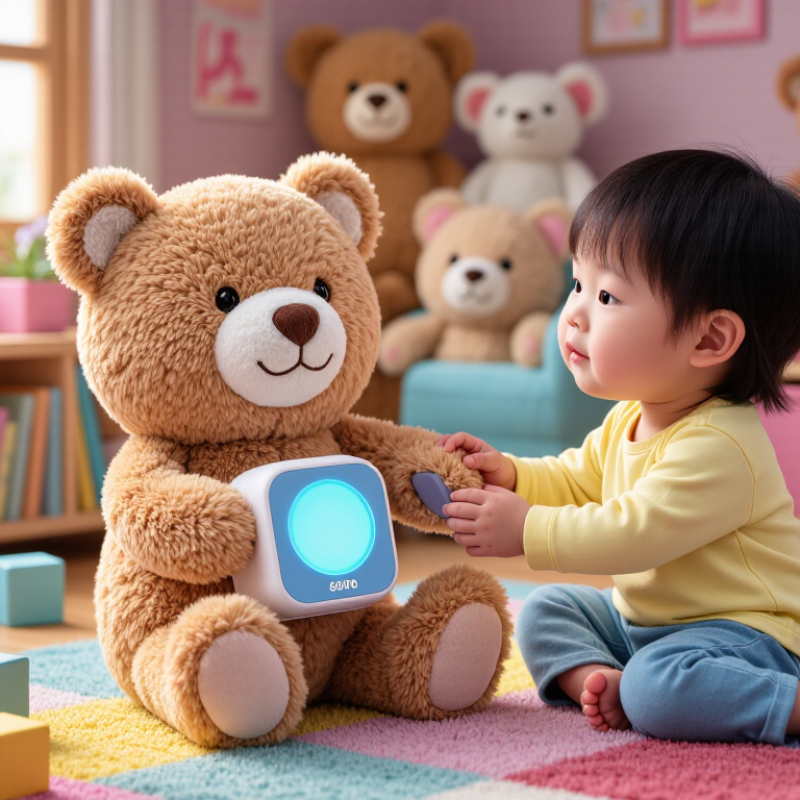
AI talking plush toys are soft toys with microphones, speakers, and small computing systems inside. They can listen to a child’s voice and respond through speech, songs, stories, or simple questions. Some models process conversations inside the toy, while others connect to an online service. This difference matters for privacy, speed, and reliability.
A child may ask about animals and hear an age-appropriate answer. The toy might also encourage counting, vocabulary, or imaginative play. Its fabric body feels familiar, so technology becomes less intimidating than a screen. That comfort may explain its growing appeal across different cultures. Still, responses can be inaccurate. The toy may misunderstand quiet speech, background noise, or a child’s unusual question.
The experience is not perfect.
Caregivers should read the instructions carefully and check microphone controls, stored data settings, and volume limits. Toys designed for children should provide clear safety information and avoid collecting unnecessary personal details. Experts also recommend adult supervision, especially when online features are enabled. A plush toy cannot replace conversation with parents, teachers, or friends. It works better as a playful tool beside human attention. My practical concern is simple: clever speech can make a toy seem wiser than it really is. Children need gentle reminders that its answers deserve checking.
Why Are AI Talking Plush Toys Popular Worldwide?
AI talking plush toys combine the emotional comfort of a traditional stuffed toy with voice-based artificial intelligence. Their appeal comes from screen-free interaction, familiar physical design, personalized responses, and the ability to support multiple languages.
The chart shows the typical functional components of an AI talking plush toy. A value of 100 indicates a core feature commonly required for that capability, while lower values represent supporting or optional functions. In practice, exact features vary by product design, connectivity, and software.
How Do AI Talking Plush Toys Work?
AI talking plush toys feel like soft companions, but their appeal depends on compact computing. Grand View Research estimates the global smart toys market could reach about 35 billion US dollars by 2030, with strong growth driven by connected play.
Inside the toy, microphones capture a child’s voice. Speech-recognition software converts sound into text. An artificial-intelligence model then identifies meaning and selects a response. Text-to-speech technology creates the spoken reply. Some systems process commands on the device, while others send data to cloud servers. The response may arrive in seconds. That delay still matters. A slow answer can break the feeling of conversation.
Sensors can detect touch, movement, or sound. A squeeze might trigger comfort, while a shake can activate a song. The Toy Association’s 2024 consumer research reported that parents increasingly value toys supporting creativity, learning, and emotional development. Yet “educational” does not always mean effective. Independent testing should examine accuracy, age suitability, microphone behavior, and data handling. UNICEF’s Policy Guidance on AI for Children stresses privacy, safety, transparency, and child-centered design.
Tips:
Check whether voice processing happens locally or online. Read the data-retention policy before buying. Test the toy with simple questions and observe its mistakes. Keep conversations supervised, especially when answers sound confident but are wrong. A child may treat a friendly voice as trustworthy. That trust needs careful limits.
What Drives Their Appeal Across Different Age Groups?
Why Are AI Talking Plush Toys Popular Worldwide?
AI talking plush toys appeal to different age groups because they combine comfort, interaction, and simple technology. For young children, a soft toy can feel like a patient conversation partner. A child may ask about rain, animals, or a bedtime story. The toy answers in a familiar voice, creating a small moment of discovery. That repetition matters. It can support vocabulary practice and imaginative play when adults remain involved. However, caregivers should check the toy’s responses. Some answers may sound confident but still be inaccurate or unsuitable.
Older children and teenagers often treat these toys as creative companions. They may invent characters, practice conversations, or use the toy to develop short stories. Personalized jokes and changing replies make the experience feel less mechanical. The toy becomes part of a bedroom routine, not just a plaything. This is not universal. Some young users may lose interest quickly. If every answer feels predictable, the magic fades.
Adults may buy talking plush toys for comfort, gifts, or shared family activities. A tired parent might use one during a quiet reading session. Grandparents may enjoy simple voice interaction without learning a complicated device. In multilingual homes, speech features can encourage casual language practice. Still, families reasonably question privacy, screen-free claims, and emotional dependence. A friendly voice can invite connection, but it cannot replace attentive human care. Responses also need cultural sensitivity, since humor and storytelling preferences differ across regions.
Why Are AI Talking Plush Toys Popular Worldwide? - What Drives Their Appeal Across Different Age Groups?
Evidence-based comparison of the main appeal factors across age groups
AI familiarity indicators are used as supporting context; they are not estimates of talking-plush-toy ownership or market share.
| Age Group |
Primary Appeal |
Why Talking Plush Toys Fit |
Supporting Evidence |
Appeal Strength |
| 0–5 years |
Comfort, attachment, and early language interaction |
A soft, familiar character can make simple questions, songs, stories, and repetition feel like play rather than formal learning. |
Early-childhood guidance consistently emphasizes responsive conversation, shared reading, play, and caregiver involvement in language development. |
High |
| 6–12 years |
Curiosity, imaginative play, and learning support |
Interactive characters can answer questions, tell stories, offer quizzes, and encourage creative role-play while retaining the tactile appeal of a toy. |
Research on children and digital technology highlights curiosity, creativity, personalization, and guided educational use as important motivations. |
High |
| 13–17 years |
Novelty, humor, self-expression, and social sharing |
The combination of a collectible object and responsive AI can create entertaining conversations, personalized jokes, and content worth sharing. |
26% of U.S. teens reported regularly using ChatGPT in a 2024 Pew Research Center survey, indicating substantial familiarity with conversational AI. |
Medium–High |
| 18–29 years |
Personalization, nostalgia, and stress relief |
Adults can enjoy the contrast between advanced conversational functions and the comforting, playful form of a plush toy. |
43% of U.S. adults aged 18–29 had used ChatGPT according to Pew Research Center survey data collected in 2023, showing strong exposure to generative AI. |
Medium–High |
| 30–49 years |
Family bonding, convenience, and educational value |
Parents and caregivers may value a device that combines entertainment, storytelling, conversation practice, and shared family activities. |
27% of U.S. adults aged 30–49 had used ChatGPT in Pew Research Center survey data collected in 2023. |
High |
| 50–64 years |
Practical assistance and intergenerational connection |
Simple voice interaction may feel more approachable than a screen-based application and can support shared conversations with children or grandchildren. |
17% of U.S. adults aged 50–64 had used ChatGPT in Pew Research Center survey data collected in 2023. |
Medium |
| 65 years and older |
Companionship, accessibility, and low-friction interaction |
A familiar physical object and voice-first operation may reduce the intimidation associated with complex interfaces, although privacy and usability are essential. |
6% of U.S. adults aged 65 and older had used ChatGPT in Pew Research Center survey data collected in 2023, suggesting lower baseline AI familiarity and a need for simple onboarding. |
Medium |
Cross-generational drivers:
tactile comfort, natural voice interaction, personalization, entertainment, learning support, emotional engagement, nostalgia, and shared family experiences. Adoption is also influenced by privacy protection, parental controls, age-appropriate design, response accuracy, and battery or connectivity requirements.
How Are Cultural Adaptation and Language Support Expanding Their Reach?
Why Are AI Talking Plush Toys Popular Worldwide?
How Are Cultural Adaptation and Language Support Expanding Their Reach?
AI talking plush toys are reaching more families because they can speak in familiar languages. A child may hear a bedtime story in Spanish, Mandarin, Arabic, or English. This creates comfort through sound, rhythm, and repetition. Short conversations can also support vocabulary practice during play. Parents often notice children speaking more freely to a soft toy than to a screen.
Cultural adaptation makes these interactions feel less generic. Developers can adjust names, greetings, humor, songs, and daily routines for different communities. A story about school lunch should not assume every child eats the same food. Native-language reviewers and early-learning specialists can check pronunciation, tone, and age suitability. Small details matter, such as using a respectful family title or recognizing a local holiday without exaggeration. Careful testing with families can reveal confusing phrases and unnatural responses.
The process is not flawless. A translated joke may sound flat. A regional accent may also be misunderstood. These toys need clear language settings, safe response limits, and reliable parental controls. They should collect as little personal data as possible. Designers must explain how voice features work in plain language. Feedback from caregivers, teachers, and speech professionals can improve later updates. Sometimes, a simple sentence works best. Children notice awkward wording quickly.
What Benefits and Concerns Shape Their Global Popularity?
Why Are AI Talking Plush Toys Popular Worldwide?
What Benefits and Concerns Shape Their Global Popularity?
AI talking plush toys attract families because they combine soft comfort with responsive conversation. A child can ask a question and hear a gentle reply within seconds. This feels more personal than pressing a button on a traditional toy.
The benefits are practical. These toys can support pretend play, vocabulary practice, and simple emotional expression. A bilingual child may hear familiar words in two languages. A child sitting alone after school may find a friendly listener beside a backpack. Caregivers also appreciate hands-free interaction during cooking or travel. Child-development professionals, however, stress that play should remain varied and guided by real relationships.
Concerns grow when convenience becomes constant companionship. Some toys may misunderstand accents, repeat inaccurate information, or respond poorly to sensitive questions. Parents should check volume levels, conversation settings, data practices, and age guidance before purchase. A microphone near a child’s bed deserves careful attention. The toy should not collect more information than necessary. It should also allow adults to pause or disable interactions.
The technology remains imperfect. That matters. A plush toy can imitate warmth, but it cannot understand a child’s full emotional history. Cultural differences create another challenge, because humor, manners, and comforting phrases do not translate equally everywhere. Responsible design needs clear controls, transparent explanations, and regular adult supervision. Popularity may continue, but trust will depend on small details, such as a quiet night mode and an honest error message.
FAQS
Microphones capture speech inside the toy. Speech-recognition software changes sound into text. An AI model then chooses a response.
Text-to-speech technology turns the selected reply into a spoken voice. The response may arrive within seconds. That delay matters.
Not always. Some toys process commands locally, while others send voice data to online servers. Check the settings carefully.
A squeeze might trigger comforting words. A shake could start a song. These small reactions make play feel more physical.
They may encourage vocabulary practice through short conversations and repeated phrases. However, “educational” does not guarantee accurate learning. Mistakes happen.
Children may feel more comfortable hearing familiar languages, names, greetings, and routines. A bedtime story can sound warmer in a child’s home language.
A translated joke may sound flat. Regional accents can confuse speech recognition. Native-language reviewers should test pronunciation, tone, and age suitability.
Check whether voice processing happens locally or online. Read the data-retention policy. Use parental controls, and supervise conversations when answers sound confident.
No. A friendly voice can sound trustworthy while giving incorrect information. Test simple questions and correct mistakes openly. Keep expectations realistic.
Conclusion
AI talking plush toys combine the comfort of traditional stuffed animals with voice interaction, sensors, and conversational software. They can respond to questions, tell stories, sing songs, offer educational prompts, and create personalized interactions through microphones, speakers, and AI systems. Their appeal extends across age groups: children enjoy playful companionship and learning activities, while parents may value interactive support and customizable content. Older users can also appreciate them as friendly conversation partners or nostalgic objects enhanced by modern technology.
Their global popularity is strengthened by cultural adaptation and language support. When these toys recognize different languages, accents, customs, and age-related preferences, they become more accessible and meaningful in diverse communities. Their benefits include entertainment, language practice, emotional comfort, and family interaction. However, concerns about privacy, screen-free attention, data protection, inappropriate responses, and overdependence also shape public attitudes. Continued success will depend on thoughtful design, transparent safeguards, parental controls, and respect for cultural differences.